Safer betting guidance for Nigerian readers

Responsible Betting Hub

Sports betting can be entertaining, but it always carries risk. A good Responsible Betting Hub should help readers enjoy betting in a controlled way, understand how bookmaker tools work, and know where to turn if betting starts affecting money, mood, relationships or daily life. Public-health guidance is clear that gambling harm is not limited to severe addiction. It can appear much earlier, and it can affect other people around the bettor as well.

Betting is not income Stake only money you can afford to lose.
Limits come first Set money and time limits before the session starts.
Act early Use support tools before harm becomes serious.

Ask these questions before you place a bet

A quick check before you stake can prevent rushed decisions, chasing losses and betting with money you need elsewhere.

01 Is this money needed for food, rent, transport, school fees or family needs?
02 Am I trying to win back a previous loss?
03 Do I understand the odds, market rules and possible payout?
04 Am I betting because I feel stressed, angry, bored or under pressure?
If one answer worries you, step back first. Use limits, take a break, or talk to someone you trust.

Need help now?

If betting is affecting money, mood, relationships or daily life, do not wait for it to become worse. Use support resources early, and call 112 in Nigeria if there is immediate danger.

What It Means

What Responsible Betting Means

Responsible betting means making informed decisions, setting limits before you start, and accepting that betting should never take priority over bills, work, sleep, relationships or mental health. The strongest regulator and operator pages all make the same core point: betting is supposed to be controlled entertainment, not a way to solve money problems or escape difficult feelings.

Betting Should Stay Entertainment, Not Income

No betting strategy removes uncertainty. Even if you understand sport, statistics and market movement, outcomes are still uncertain and losses are always possible. That is why responsible betting begins with the mindset that money staked is entertainment spend, not expected income. This is also the best place to link to your guide on odds, stake, payout and implied probability, so readers understand what they are risking before they place a bet.
Know the Risks Before You Start

Gambling can affect finances, relationships, mental health and family life. The WHO also notes that harm can exist below the threshold of a clinical diagnosis, which means you do not need to hit rock bottom before taking the issue seriously. Responsible betting starts with recognising that risk early.

Betting Basics

Learn the Basics Before You Bet

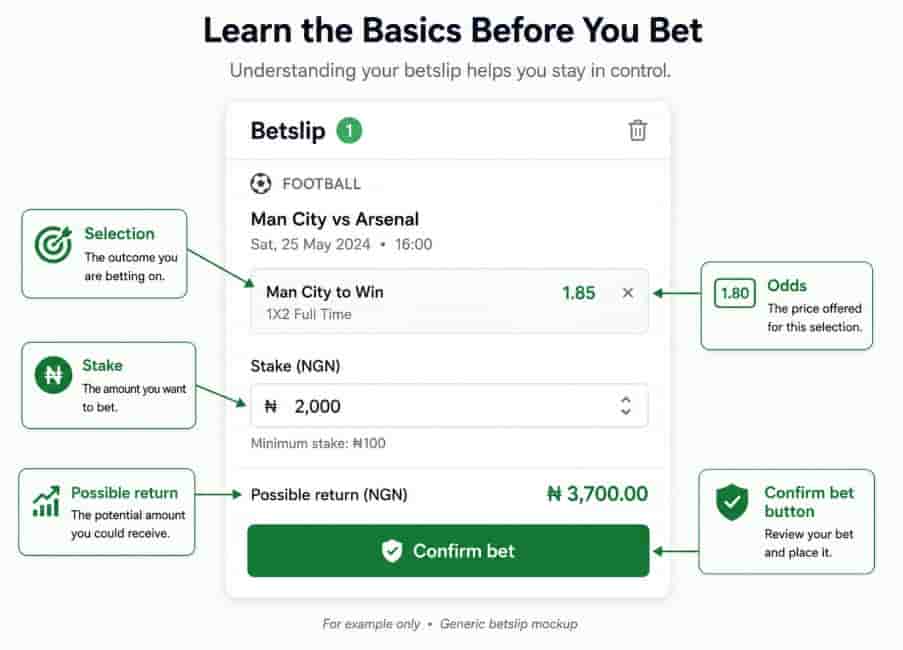
Safer betting also means understanding what you are doing before you place a stake. If you are new to betting, start with the full beginner guide first. It explains odds, betslips, stakes, payouts and simple bet types in one place, while the glossary can help you check unfamiliar betting terms quickly.

Generic betslip example explaining selection, odds, stake, possible return and the confirm bet button
Example only: use the beginner guide and glossary to understand each part of a betslip before staking money.
Safer Betting Reminders

Simple rules to keep betting under control

These reminders are not complicated, but they are the habits that matter most before and during a betting session.

01 Set your ₦ budget first

Decide the amount before opening a betting app, website or shop coupon.

02 Protect essential money

Do not use rent, food, transport, school fees, business cash or family money.

03 Stop at the session limit

End the session when the limit is reached, even after losses or close calls.

04 Use stronger tools when needed

Deposit limits, time-outs, self-exclusion and blocking tools can add protection.

Control Rules

Practical Rules to Stay in Control

The simplest rules are still the most useful. Most official advice on safer gambling repeats the same behaviours because they work: limit what you spend, limit how long you bet, do not chase losses, and step back when betting stops being fun.

Set Limits Before You Bet

Decide your money limit and time limit before you open an app or website. It is much easier to stay disciplined before a betting session starts than during a winning streak or losing run. If possible, write your limit down or tell someone you trust.

Never Chase Losses

Chasing losses is one of the clearest warning signs in gambling guidance from regulators, health services and support organisations. If you have reached your limit, the session is over. Trying to win it back often leads to bigger losses and worse decisions. A simple guide on why chasing losses fails can be useful, but the main rule is even simpler: once you reach your limit, stop the session.

Bet With a Clear Head and Keep Records

Do not bet when you are angry, stressed, low, drunk or trying to distract yourself from other problems. It also helps to review your history regularly: when you bet, what you stake, and whether your behaviour changes after wins or losses. Good records make it easier to spot patterns before they become a problem.

Sportsbook Tools

Safer Betting Tools You Should Use

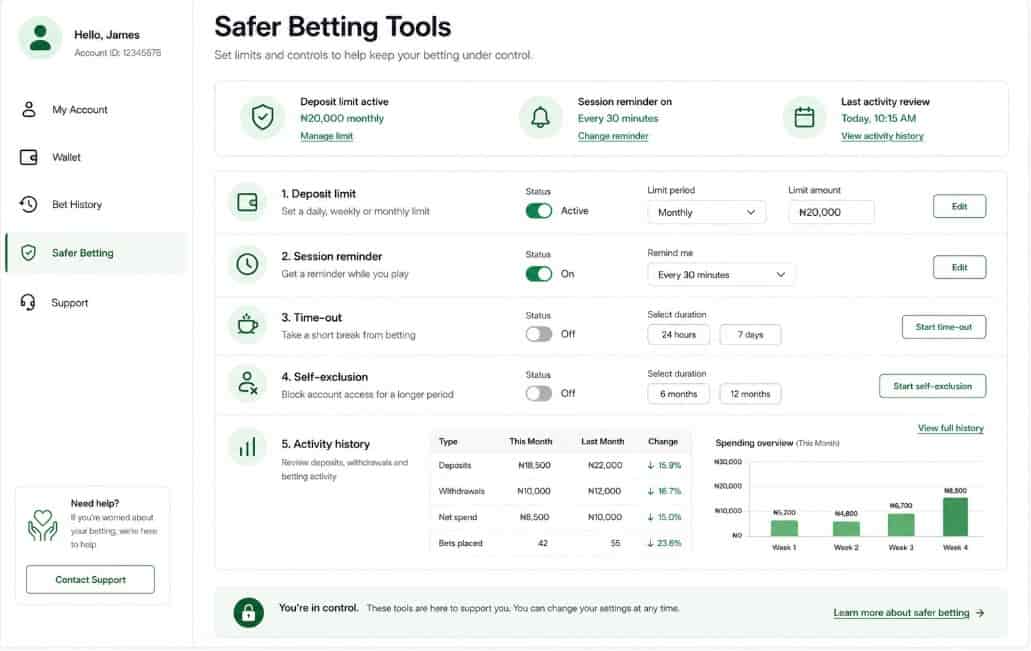
A responsible betting page should not stop at advice. It should explain the practical controls that many bookmakers and apps already offer. Competitor pages rank well when they show users exactly which tools exist and how those tools help.

Mock sportsbook account screen showing safer betting tools in Nigeria including deposit limits, session reminders, time-outs, self-exclusion and activity history
Example account screen: look for practical controls such as deposit limits, session reminders, time-outs, self-exclusion and activity history.

Deposit, Spend and Loss Limits

Many betting sites allow users to cap deposits, spending or losses for a day, week or month. These are some of the simplest and most effective controls available, especially when increases do not take effect immediately. If you review betting brands, consider rating each bookmaker on whether these limits are easy to find and easy to use.

Session Reminders, Activity Statements and Reality Checks

Some operators provide activity pages, session reminders, play-time notifications, account history and profit/loss views. These tools matter because they turn vague feelings into visible data. They help bettors see how often they play, how much they spend and whether their behaviour is changing.

Time-Outs, Self-Exclusion and Blocking Tools

If a bettor needs a short break, a time-out or cooling-off period can help. If the problem feels more serious, self-exclusion is a stronger step that blocks account access for a defined period. Extra protection can come from payment blocks through a bank and device-level tools such as BetBlocker or Gamban. Using more than one layer often gives better protection than relying on a single tool.

Warning Signs and Support

Warning Signs and Support

A strong Responsible Betting Hub should normalise early check-ins. The goal is not to diagnose people on a review site. The goal is to help readers notice risk early and move towards support before the damage becomes more serious.

Signs Your Betting May Be Becoming Harmful

Common signs include spending more time or money than planned, chasing losses, hiding or lying about betting, borrowing money, feeling guilty or irritable, thinking about betting constantly, and neglecting work, family or social life. If several of those feel familiar, it is time to act rather than hoping the next win fixes it.

Questions to Ask Yourself

Ask yourself a few direct questions. Are you betting more than you can afford? Are you increasing stakes to feel the same excitement? Are you trying to win back losses? Has betting caused stress, anxiety, secrecy or money problems at home? Honest answers matter more than any label.

Immediate danger: If you might harm yourself or someone else, call 112 now or go to the nearest emergency service.

Where to Get Help for Yourself or Someone Else

Support should be easy to find and clearly signposted. Global options such as Gambling Therapy and peer-support groups such as Gamblers Anonymous are useful starting points, while country-specific regulators, helplines and treatment services can provide more targeted help. It is also important to remember that family and friends may need support too, not just the person placing the bets.

Private Self-Check

Gambling Self-Assessment Test

Use this private self-check as a first step if you are unsure whether betting is starting to create harm. The tool does not store or send your answers.

Choose Better

How to Choose a Safer Betting Site

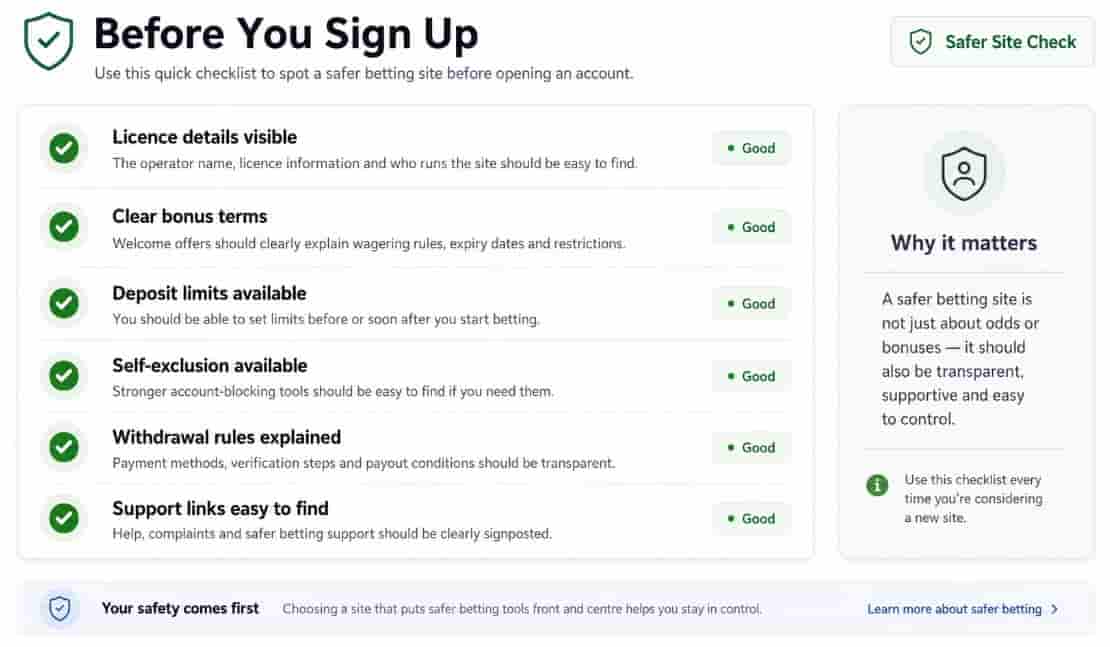
Your readers come to you for bookmaker reviews, so this section should connect responsible betting to site selection. A safer bookmaker is not just one with good odds. It is one that is licensed, transparent and equipped with proper control tools.

Safer betting site checklist showing licence details, clear bonus terms, deposit limits, self-exclusion, withdrawal rules and support links
Use this checklist before opening an account: a safer site should be transparent, supportive and easy to control.

Check the Licence, Terms and Complaints Process

Before signing up, readers should check who runs the site, whether the brand is licensed in the relevant market, what the bonus restrictions are, and how complaints are handled. Good operators make their terms, licence details, complaints process and player protections visible. Guides on licensing, KYC and how withdrawals work can also help readers understand what to check before joining a site.

Look for Safer-Betting Tools Before You Sign Up

Responsible bettors should review control tools before opening an account, not only after problems appear. Look for deposit limits, loss limits, reality checks, activity statements, time-outs, self-exclusion and clear support links. If a bookmaker hides these tools or explains them badly, that is a trust signal in the wrong direction.

What we check in bookmaker reviews

Deposit limits, spend limits and loss limits.
Reality checks, activity statements and profit/loss history.
Time-outs, self-exclusion and links to support resources.

See how we rate and review betting sites.

Family Protection

Protecting Children and Vulnerable People

Responsible betting content should never focus only on the active bettor. It should also cover under-18 protection, account privacy and the importance of not normalising gambling around young people. Major regulators and safer-play groups all treat this as a core part of player protection.

Under-18 Betting, Shared Devices and Payment Methods

Betting is for adults only. Do not share accounts, saved passwords or payment methods with children, and make sure betting apps are not left open on shared phones or tablets. In Lagos State, for example, the regulator explicitly states that persons under 18 must not take part in betting, gambling or lottery activity.

Talking to Family About Betting Risks

Young people are exposed to betting language through sport, advertising, social media and peer conversations. Families should treat gambling like any other adult-risk product: talk openly about age limits, financial risk and why betting should never be seen as a shortcut to easy money.

Account and device safety

Use device locks, avoid saving betting passwords on shared phones, and do not let someone else use your betting account or payment method. This protects both the account holder and vulnerable people around them.

FAQs

Responsible Betting FAQs

A short FAQ helps readers who want direct answers and also matches the structure of several high-visibility competitor pages. It is worth keeping these answers plain, practical and honest.

Is Responsible Betting Only for People With a Gambling Problem
No. Responsible betting is for every bettor, including complete beginners. The aim is prevention: understanding the risks, setting limits and noticing harmful patterns early. Waiting until betting has already caused serious damage is the opposite of responsible play.
Can Betting Ever Be Risk-Free
No. You can reduce risk, but you cannot remove it. Knowing the odds, choosing markets carefully and using controls may help you make better decisions, but no system can make sports betting safe from loss.
When Should I Stop Completely
If betting is affecting your bills, debt, work, sleep, relationships, mood or honesty, it is time to stop and seek support. The same applies if you keep chasing losses, borrowing money or feeling unable to cut down. Acting early is a strength, not a failure.

Betting should stay entertainment

This page is for safer-betting education only. TopBettingSites.ng does not provide gambling services. Betting is for adults only and should never be treated as a way to make money.

Contact Us →